
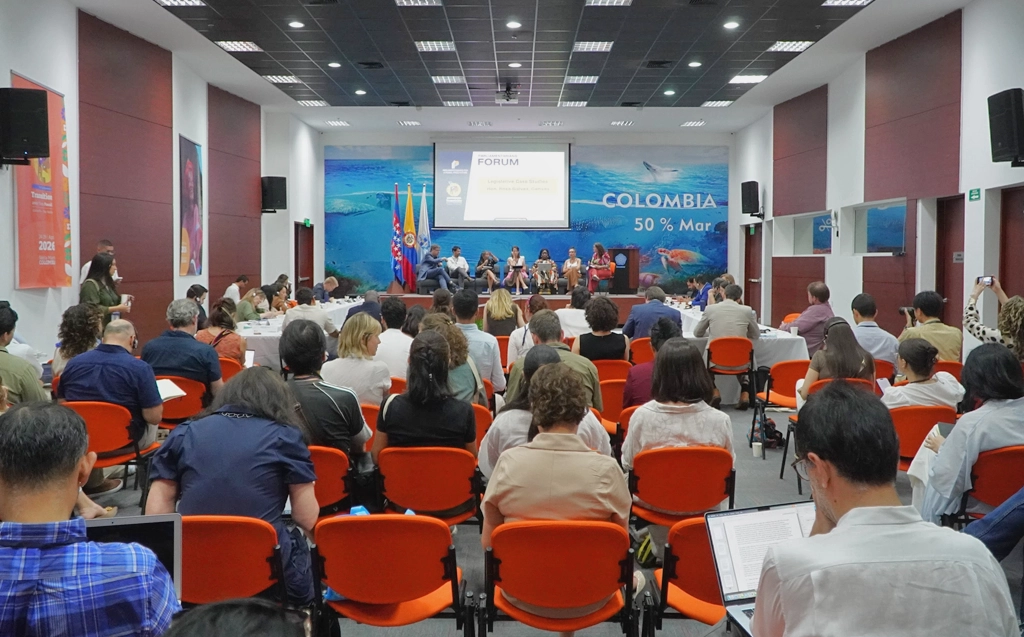
Santa Marta, Colombia | 27 April 2026
Parliamentarians from more than 35 countries today called for an urgent acceleration of the transition away from fossil fuels, stressing that global ambition must now be translated into concrete laws, public budgets, and long-term national frameworks.
As the First International Conference on Transitioning Away from Fossil Fuels continues in Santa Marta (Colombia), the Parliamentarians for a Fossil-Free Future network is using today’s parliamentary press conference to make one urgent political point clear: the world must accelerate a just energy transition not only because the fossil fuel era is ecologically unsustainable, but because continued dependence on oil, gas and coal is also deepening social injustice, economic vulnerability and geopolitical instability.
The parliamentary network said that, throughout the global parliamentary process leading up to Santa Marta, one message returned again and again across regions: fossil fuel dependence is not merely an environmental problem. It is also a structural political and economic problem that leaves countries vulnerable to conflict, coercion, external interference and volatile energy systems.
The parliamentary process leading to Santa Marta—bringing together lawmakers through surveys, virtual dialogues, and the Parliamentary Forum held on 26 April—has generated a strong and consistent message: the transition must now move from ambition to implementation.
From Ambition to Implementation
Parliamentarians are clear: the transition away from fossil fuels will only succeed if ambition is translated into laws, public budgets, oversight, and long-term national frameworks. Santa Marta must mark a shift from declarations to real implementation through legislatures.
Finance Must Enable, Not Constrain, the Transition
A just transition requires financial systems that expand fiscal space, not deepen debt. Public finance must move away from fossil fuels and toward renewable energy, while stronger policies are needed to redirect private finance and ensure accountability and transparency.
A Just Transition is a Matter of Equity and Cooperation
The transition is not only a climate issue—it is a matter of fairness, development, and global cooperation. Countries face different realities, and there is no credible pathway without accessible, non-debt-inducing international support, stronger oversight, and coordinated parliamentary action across borders.
Recent geopolitical developments have also reinforced the urgency of reducing fossil fuel dependence, highlighting how oil and gas systems remain closely linked to economic shocks, conflict, and global instability. The current conflict in the Middle East has roiled oil and gas markets, damaged energy infrastructure, and exposed entire regions to economic disruption, demonstrating once again how fossil-fuel-based systems magnify insecurity far beyond the battlefield.
Members of the network also pointed to developments in Venezuela as a stark reminder that oil wealth continues to shape external power struggles in the Americas. U.S. policy toward Venezuela this year has been closely tied to control over the country’s oil sector; shortly after U.S. removal of Nicolás Maduro, President Donald Trump openly said Venezuela would “turn over” tens of millions of barrels of oil to the United States and pressed for broad U.S. access to the country’s oil industry.
For the parliamentary network, these developments reinforce a central lesson: fossil fuels are not only heating the planet. They are also helping sustain a world order in which powerful states and economic actors continue to make decisions over territories, peoples and resources through the logic of extraction, force and dependency.
A just transition away from fossil fuels, parliamentarians said, would therefore deliver benefits well beyond emissions reduction. It would help protect nature, reduce exposure to price shocks, improve public health, support fairer economic planning, and weaken one of the structural drivers of war, dispossession and poverty in the international system.
“Our call is clear: the world must accelerate a just transition away from fossil fuels. This is not only an environmental imperative. It is also a social, economic and geopolitical necessity. In recent months, the world has once again seen how oil and gas dependence can fuel instability, deepen inequality, and expose countries to war, coercion and external interference. Moving beyond fossil fuels is essential not only to protect the climate and nature, but also to build a more peaceful, fair and resilient world,” Parliamentarians For a Fossil-Free Future jointly said.
Today’s message is not intended to pre-empt the final outcome of the parliamentary track. Rather, it is meant to reflect the urgency of a concern that has been consistently voiced by legislators throughout the process: that as long as the world remains locked into fossil-fuel dependence, it will remain locked into repeated cycles of environmental destruction, instability, social harm and geopolitical confrontation.
Parliamentarians expressed hope that the Santa Marta Conference will help shift the global conversation from declarations to implementation, recognizing that moving beyond fossil fuels is essential to building a more stable, equitable, and sustainable future.
About the parliamentary process
The parliamentary process leading to Santa Marta has unfolded over several weeks and has included written consultations, regional virtual dialogues and the Parliamentary Forum held on 26 April. More than 35 countries have been represented in this process, coordinated by Parliamentarians for a Fossil-Free Future. The work continues, with further parliamentary messaging expected ahead of the Conference’s High-Level Segment.
Media contact
Nicolás Bustamante
Communications Lead
Parliamentarians for a Fossil-Free Future
nicolas@parlfossilfree.org
+57 3132496539